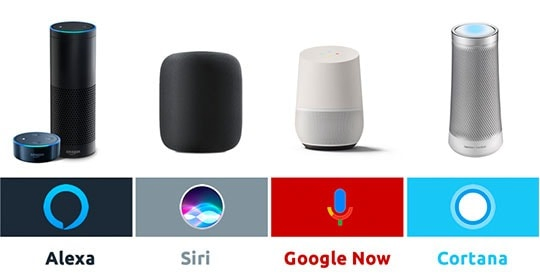
Voice assistants are software agents that interpret human speech in order to carry out certain commands and provide specific information that is requested by the user (Hoy, 2018). This technology is widespread today and functions to assist many people in different ways everywhere. Voice assistants are integrated into many different devices that people utilize daily: iPhones, iPads, computers, smart speakers, etc. (“What is a Voice Assistant”, 2019). The fact that this software is embedded in practically every device that humans use everyday showcases how advanced this technology has become and its strong influence on human life. Voice assistants, also known as digital assistants and virtual assistants, are the first application that exposes consumers to the power and potential of artificial intelligence, and the spectrum of its capability continues to expand (Shih, 2020).
There are many different kinds of virtual assistants that exist today and that are used popularly by consumers (Siri, Alexa, Google Assistant, Cortana), and each of them share similar capabilities, whilst also having unique ones. Alexa and Google Assistant have the ability to define routines to perform a set of tasks with a single voice command. For example, when the user says, “Hey Google, good morning,” Google Assistant can execute a sequence of predefined tasks, such as adjusting lights and thermostats, giving weather reports, estimating commuting time, looking up and stating calendar events, providing reminders, playing news, radio, or music, etc. (Shih, 2020). Siri was the first voice assistant to make history and was a turning point in artificial intelligence back in 2011. Siri started out on an iPhone and was called upon by pressing down on the home button. Today, Siri can be summoned just by saying the command “Hey Siri” and is capable of many things: translate, show the weather forecast, look up sports statistics of recent games, find the nearest places to eat, give directions, etc. The possibilities for these virtual assistants continue to become endless. Voice assistants have even become popular among the blind or vision impaired because they are now able to command their software audibly to turn on the lights or read out bank statements or other commands without having to do it themselves, saving them a lot of trouble (Matthews, 2019). This amazing technology is flexible, useful and its making people’s lives easier as well.
Since the time Siri was introduced to the public, Voice assistant technology has become a big part of US households and has become an important part of many people’s daily lives. According to a 2018 survey, 72 percent of 1,000 participants indicated that they have used a virtual assistant. Furthermore, 44 percent of these survey respondents have used VAs to control another smart device at home.8 A 2019 survey estimated that more than 110 million people in the US use VAs at least monthly, a 9.5 percent jump from 2018. Smart speakers are now a common household item, with more than 133 million in use in the US and about 26 percent of US consumers owning smart speakers (Shih, 2020). The expansion of voice assistants is quite rapid and continues to become more and more popular.